Specialisation Project (TSM) · 2026
Selection Studies for the Search of Bs0 → τ+τ− Decay using Boosted Decision Tree
Overview
The rare decay Bs0 → τ+τ− is one of the most theoretically clean probes of physics beyond the Standard Model accessible at the LHC. As a Flavour-Changing Neutral Current (FCNC) process, it is forbidden at tree level and can only proceed through higher-order loop diagrams — the penguin and box topologies — making its branching ratio exquisitely sensitive to any new heavy particles that might contribute in the loop. The Standard Model predicts ℬ(Bs0 → τ+τ−) = (7.73 ± 0.49) × 10−7; the best experimental upper limit to date (LHCb Run 1, 3 fb−1) sits three orders of magnitude higher at 6.8 × 10⁻³ (95% CL), leaving enormous room for new physics to hide.
This project developed a dedicated selection strategy for this decay using part of the LHCb Run 3 dataset collected in 2024, focusing on the fully hadronic τ− → π−π+π−ντ mode. Two complementary analyses were performed: (1) an optimised Boosted Decision Tree (BDT) to suppress combinatorial background, achieving a test AUC of 0.957 — up from 0.932 in prior work — with 0.46% background efficiency at 60% signal efficiency; and (2) a first study of the physics background B0 → D−3π, where a newly discovered 6π invariant mass cut reduces its overall efficiency to 22.20% while retaining 64.21% of signal.
Physics Background
Why Bs0 → τ+τ−?
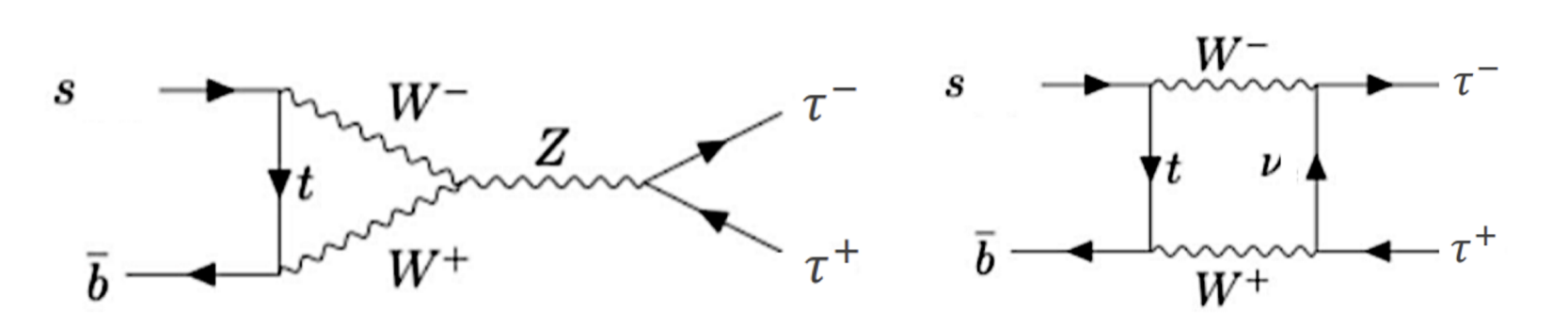
FCNC processes in the B-meson system are a cornerstone of indirect searches for new physics. In the Standard Model, b → s transitions can only occur via virtual W/Z loops or box diagrams involving top quarks — Fig. 1. Any new heavy particle (e.g. a charged Higgs, leptoquark, or SUSY partner) that couples to b and s quarks would modify the loop amplitude and shift the branching ratio away from the SM prediction. The τ+τ− final state is additionally helicity-suppressed in the SM (the Bs is a pseudoscalar; the τ pair must be produced with opposite helicities), which further suppresses the rate and amplifies the sensitivity to scalar new-physics operators that lift the helicity suppression.
LHCb Run 3 Advantage
Run 3 (from 2022) brought a pivotal upgrade to LHCb: the hardware Level-0 trigger was removed and replaced by a fully software-based system (HLT1 on GPUs + HLT2) reading out at the full 30 MHz bunch-crossing rate. Combined with an instantaneous luminosity five times higher than Run 2 (2 × 1033 cm−2s−1) and a slight increase in centre-of-mass energy from 13 to 13.6 TeV, this delivers a Bs signal yield roughly 8× larger per unit time than Run 1. The analysis uses data from blocks 7 & 8 of the 2024 run, corresponding to an integrated luminosity of 1.172 fb−1.
Signal Topology & Backgrounds
Signal: 6π + 2ν final state
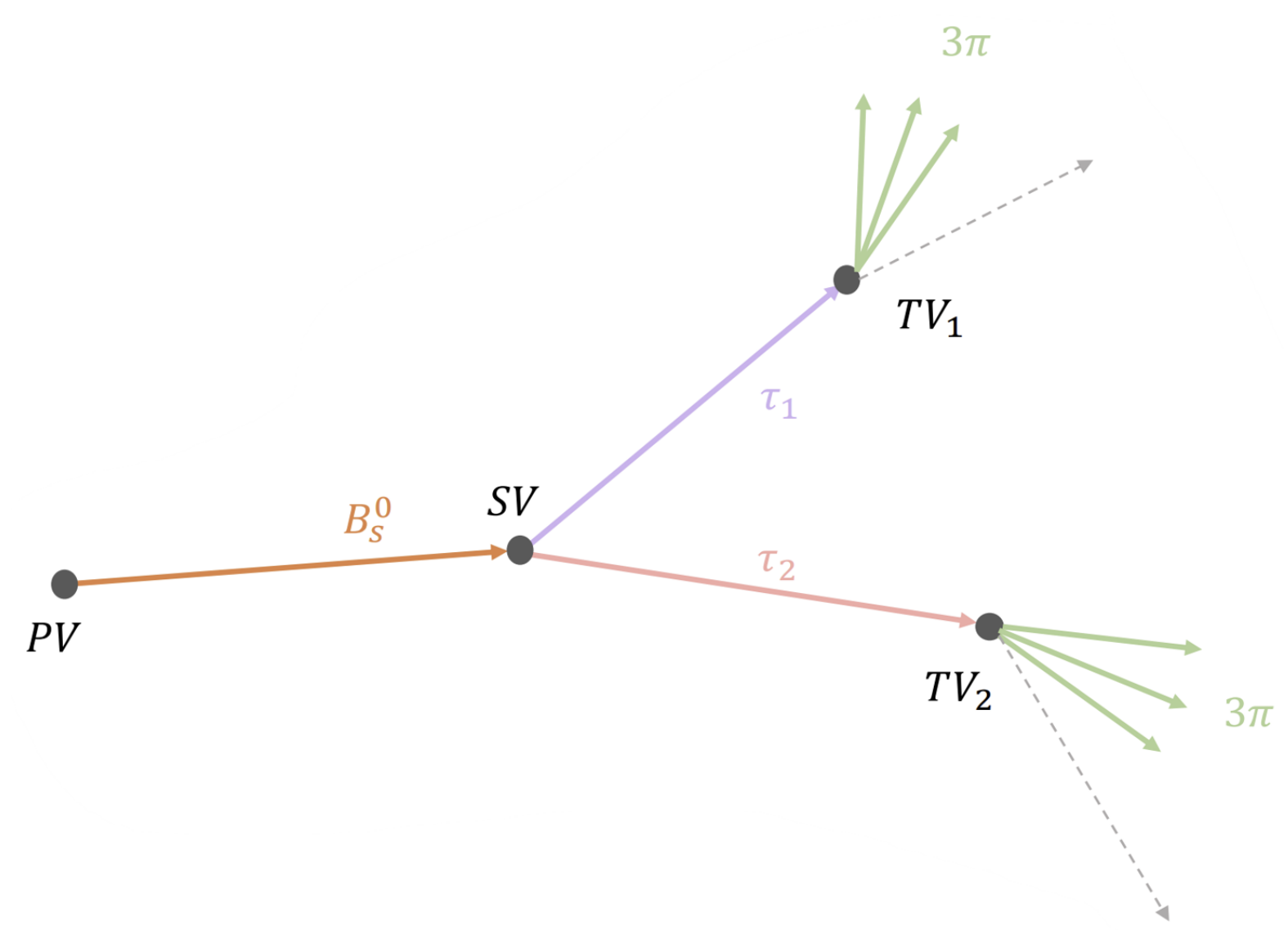
Both τ leptons are reconstructed through their hadronic three-prong decay τ− → π−π+π−ντ (branching ratio 9.31%). Although this hadronic mode has a smaller branching ratio than the leptonic channels (μν or eν), it offers a decisive advantage: each three-pion group forms a secondary vertex (TV1, TV2) geometrically displaced from the Bs0 decay vertex (SV), providing strong topological discrimination against combinatorial background. Furthermore, the decay proceeds predominantly through the resonant chain τ− → a1(1260)−ντ → ρ0(770)π−ντ, allowing kinematic constraints on the intermediate ρ mass to be exploited as discriminating variables.
The two missing neutrinos prevent full kinematic reconstruction of the Bs0 invariant mass — the standard discriminant in B-physics — making this search significantly more challenging than, say, Bs0 → μ+μ−.
Background sources
Two classes of background must be suppressed:
- Combinatorial background: random combinations of six pions from unrelated processes that accidentally satisfy the selection criteria. Same-Sign (SS) data — events where both reconstructed τ candidates have the same charge (τ±τ±) — provides a data-driven proxy for this background, since real Bs0 → τ+τ− decays cannot produce same-sign pairs.
- Physics background: genuine B-meson decays that produce a 6π final state mimicking the signal topology, such as Bs0 → Ds+Ds− or B0 → D−3π. These are much harder to suppress because their kinematics are similar to the signal.
Data Samples
All four samples were selected with the dedicated HLT2 line Hlt2RD_BdToTauTau_TauTo3Pi_OS, which applies rectangular pre-cuts on the 3π invariant mass (720–1550 MeV/c2) and the 2π invariant mass (600–1050 MeV/c2) to enrich the sample in signal-like topologies.
| Sample | Description | Initial events (post-HLT2) |
|---|---|---|
| MC Signal | Simulated Bs0 → τ+τ− → (π+π−π+ν̄τ)(π−π+π−ντ) | 4,772 (2 M generated) |
| MC Physics Background | Simulated B0 → (D− → π−π+π−π0) π+π−π+ | 3,104 (2 M generated) |
| SS Data (Comb. proxy) | Same-sign τ±τ± events, blocks 7 & 8, 2024 | 8,481,222 |
| OS Data (Search region) | Opposite-sign τ+τ− events, blocks 7 & 8, 2024 | 12,963,547 |
The integrated luminosity of blocks 7 & 8 is 1.172 fb−1, out of 9.56 fb−1 for the full 2024 dataset. Based on the b̄b production cross-section (scaled from 13 to 13.6 TeV), the fragmentation fraction fs ≈ 10.5%, the SM branching ratio, and the HLT2 efficiency of 1.7%, only 2.26 signal events are expected in this subsample — confirming that this analysis establishes selection limits rather than an observation, with the full 2024 dataset yielding ~21.6 expected events.
Analysis: Combinatorial Background Suppression
Step 1 — ΔmBs⁰ Pre-selection Cut
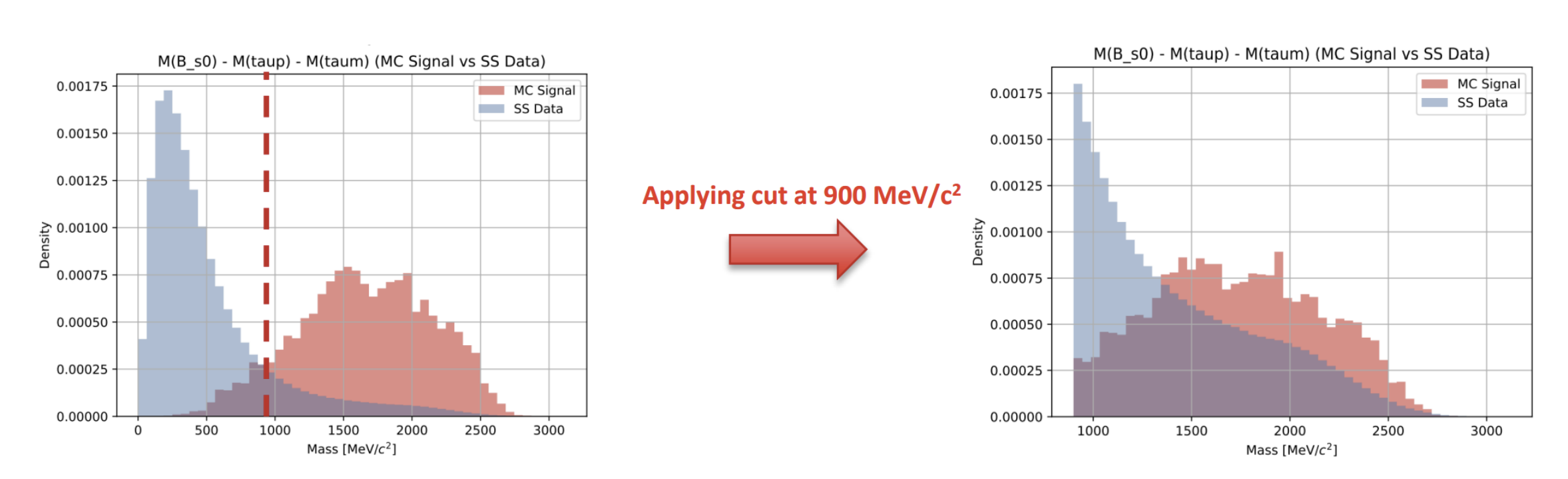
Since the two neutrinos are invisible, the full Bs0 mass cannot be reconstructed. Instead a proxy variable is defined:
ΔmBs⁰ = mrecBs⁰ − mrecτ+ − mrecτ−
where each mass is the invariant mass of the corresponding visible pion system (6π for Bs0, 3π for each τ). For genuine Bs0 decays, the missing neutrino momentum means ΔmBs⁰ peaks at positive values, while combinatorial background piles up near zero. A rectangular cut at 900 MeV/c2 retains 92.52% of signal while rejecting over 85% of combinatorial background.
| Sample | Events before | Events after | Efficiency |
|---|---|---|---|
| MC Signal | 4,772 | 4,415 | 92.52% |
| SS Data (Comb. Bkg) | 8,481,222 | 1,234,561 | 14.56% |
| OS Data | 12,963,547 | 1,791,389 | 13.82% |
Step 2 — XGBoost Boosted Decision Tree
A Boosted Decision Tree using the XGBoost algorithm is trained on MC signal vs. SS data to further separate signal from combinatorial background. Hyperparameters were optimised via Bayesian search over 15 iterations of 3-fold cross-validation. To handle the extreme class imbalance (signal ≪ background), sample weights proportional to inverse class frequency were applied during training.
Key design choice: Two new isolation variables (B_s0_VTXISO_OneTrack_Smallest_DELTACHI2_MASS and B_s0_VTXISO_OneTrack_Sum_CHI2_DCHI2) contain NaN when no nearby tracks exist — a sign of perfect vertex isolation. XGBoost handles NaN natively by routing those events down the high-signal branch, directly exploiting the isolation signature without any imputation.
A second improvement over prior work was replacing the max_rho_mass_diff variable — the maximum of (mππ − mρ) — with min_rho_mass_diff = min|mππ − mρ|. The original formulation correlated strongly with the 3π invariant mass (because the maximum di-pion pair is always the heaviest one), masking the true ρ resonance signature. Taking the minimum absolute difference selects the pion pair most consistent with a ρ0, faithfully capturing the τ → a1 → ρπ decay chain.
BDT Input Features
The 14 input features split into kinematic and isolation categories:
| Feature | Physical meaning |
|---|---|
| Kinematic | |
pv_tau_angle_deg | Angle between PV→TV1 and PV→TV2 vectors (deg) |
min_log10_one_minus_OWNPV_DIRA | Min log₁₀(1 − DIRA) across both τ candidates; DIRA measures flight-path alignment |
taup/taum_three_pi_mass | Reconstructed 3π invariant mass for each τ candidate |
min_log10_BPV_IPCHI2 | Min log₁₀(IP χ²) of both τ candidates w.r.t. the primary vertex |
taup/taum_min_rho_mass_diff | Min|mππ − mρ| for each τ; selects the pair closest to the ρ mass |
min_prod_probnn_pi | Min of the product of PROBNN_PI for all three pions in each τ candidate |
tau_end_vertex_distance | Euclidean distance between the two τ end vertices |
| Isolation | |
B_s0_VTXISO_OneTrack_NParts | Number of tracks compatible with the Bs0 vertex — low for isolated signal |
B_s0_VTXISO_OneTrack_Smallest_DELTACHI2_MASS | Mass of the track with smallest Δχ² added to the vertex (NaN if none) |
B_s0_HEAD_NC_BIso10_Range_PT | pT range of tracks in neutral cone (radius 1.0) |
B_s0_HEAD_CC_BIso05_PASY | Charged-cone asymmetry (phead − pcone)/(phead + pcone) |
B_s0_VTXISO_OneTrack_Sum_CHI2_DCHI2 | Sum of smallest χ² and Δχ² for tracks added to the vertex (NaN if none) |
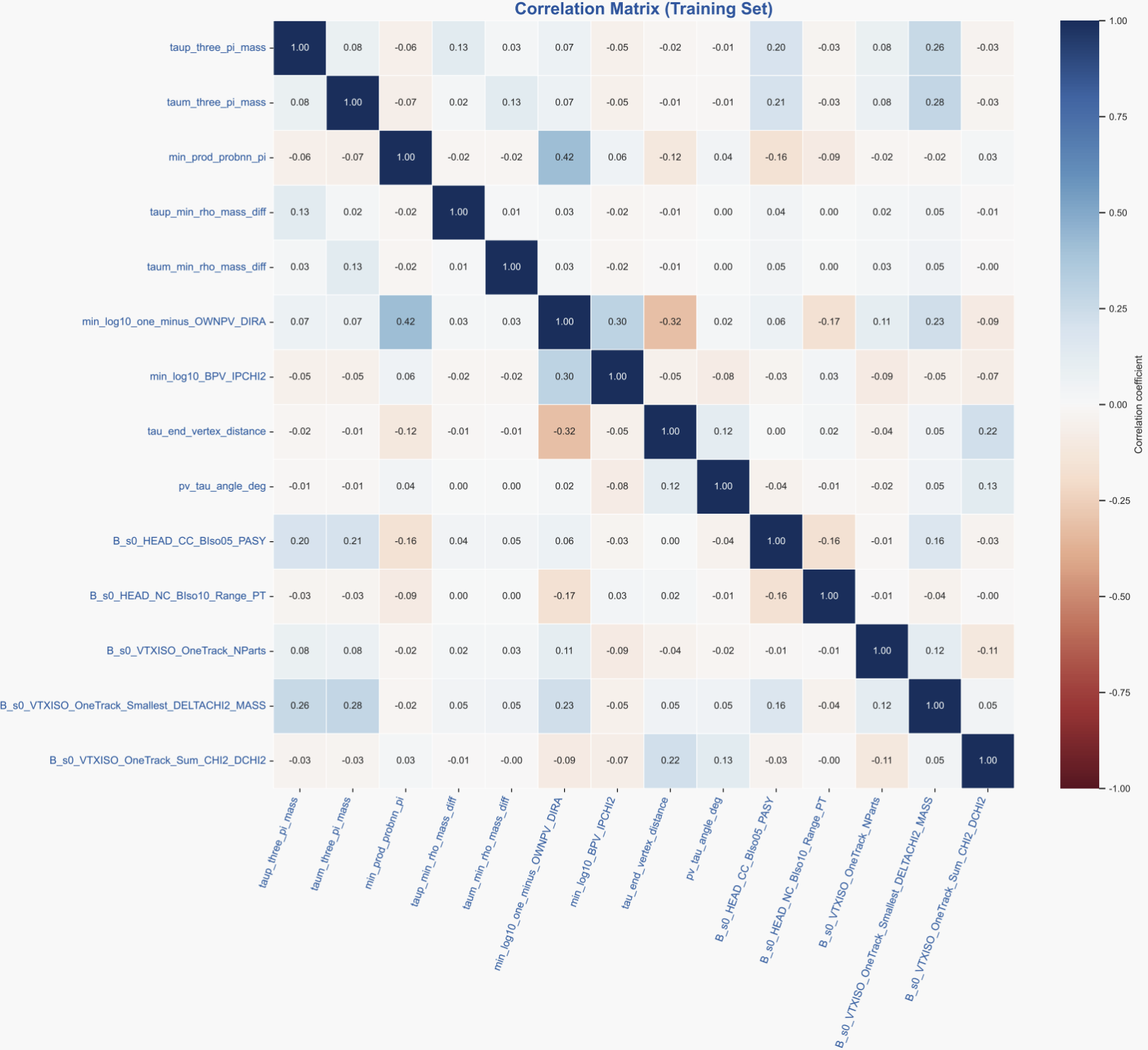
min_rho_mass_diff version), and between DIRA and PROBNN (both probe track reconstruction quality). Isolation variables are largely uncorrelated with kinematic features.Training Results
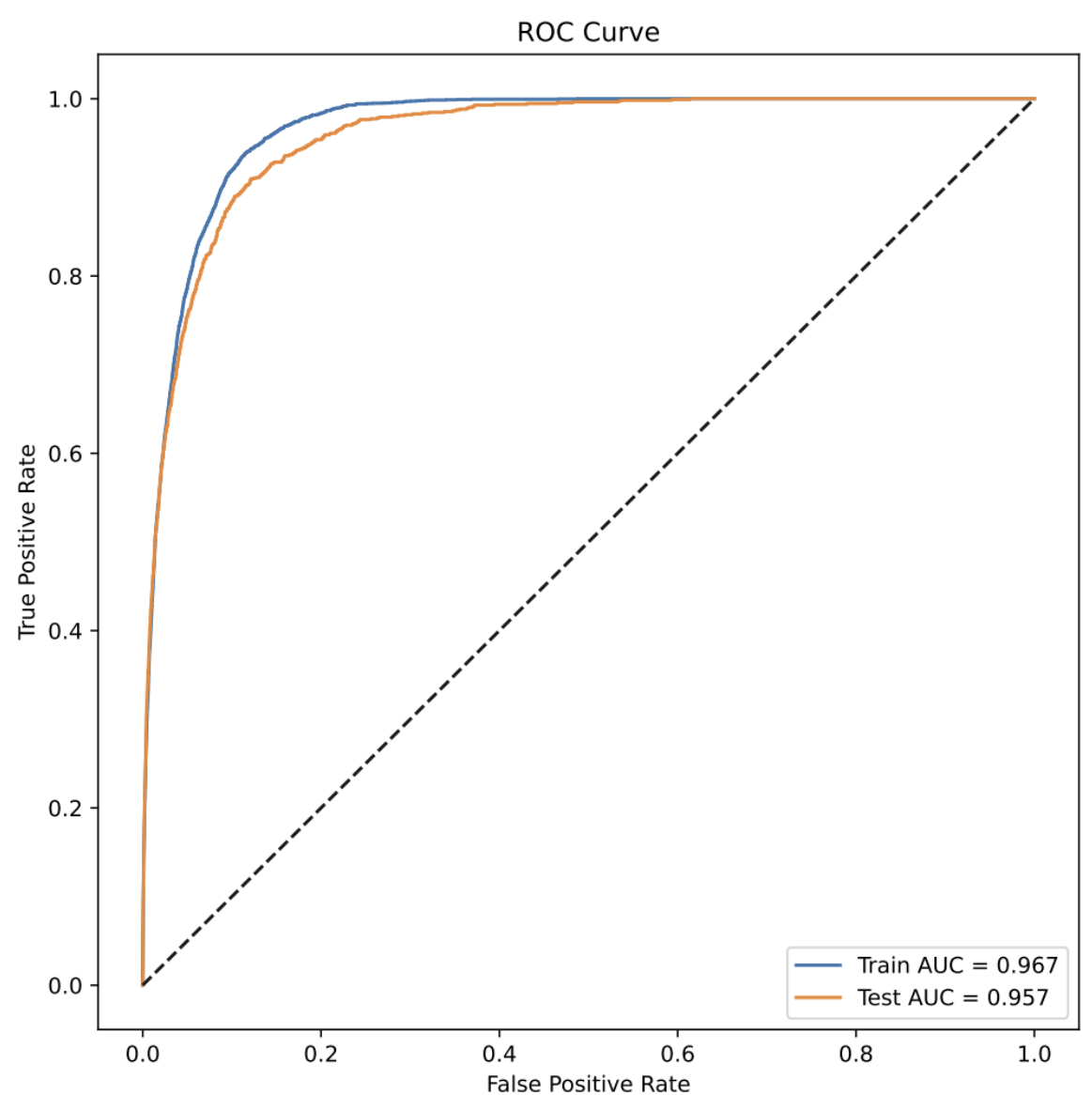
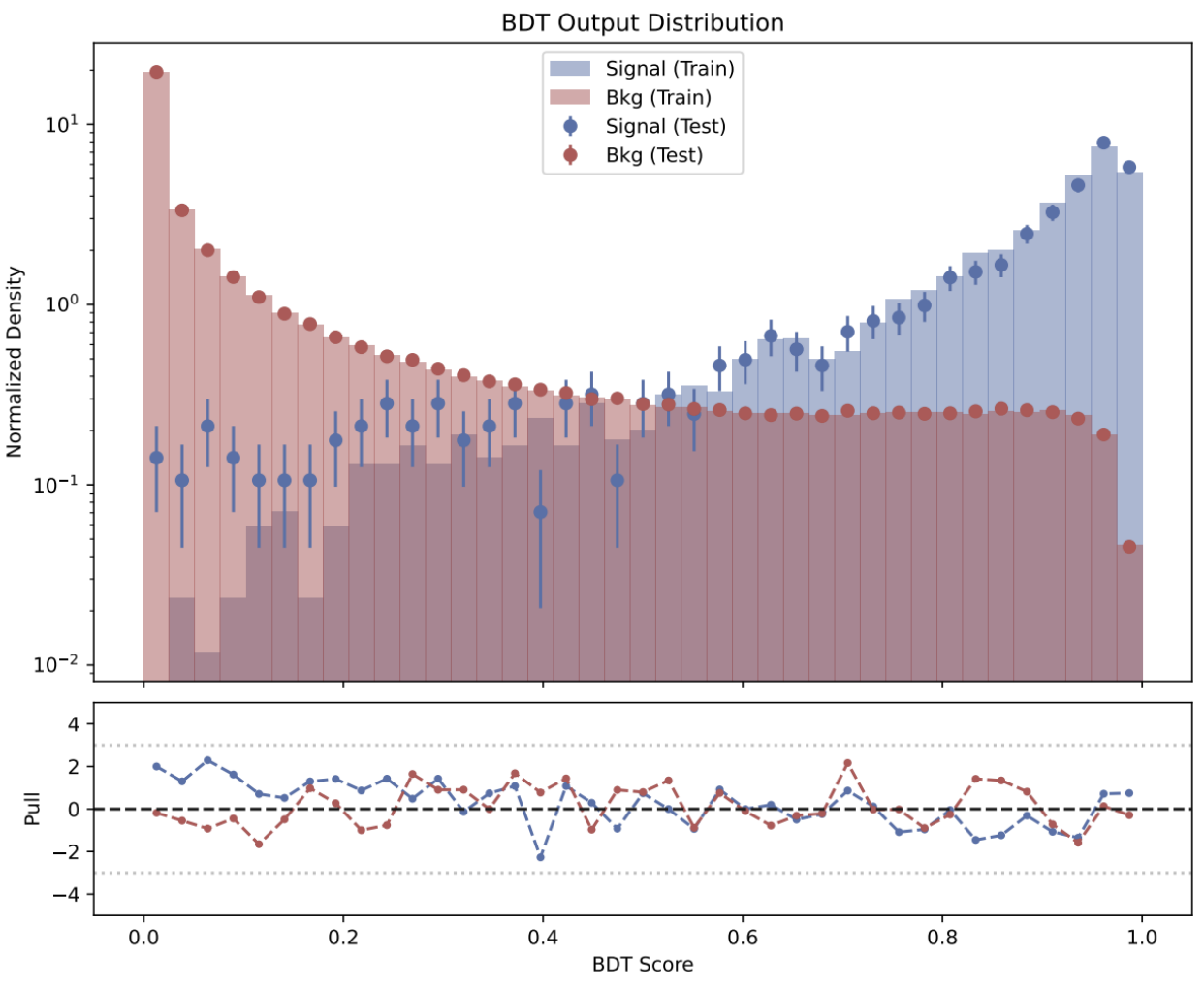
BDT performance: Test AUC improved from 0.932 (prior study) to 0.957. At a BDT threshold of 0.8230, the overall combinatorial background efficiency (including the Δm pre-cut) drops to 0.46% — down from 0.70% — while retaining 60.00% of signal events.
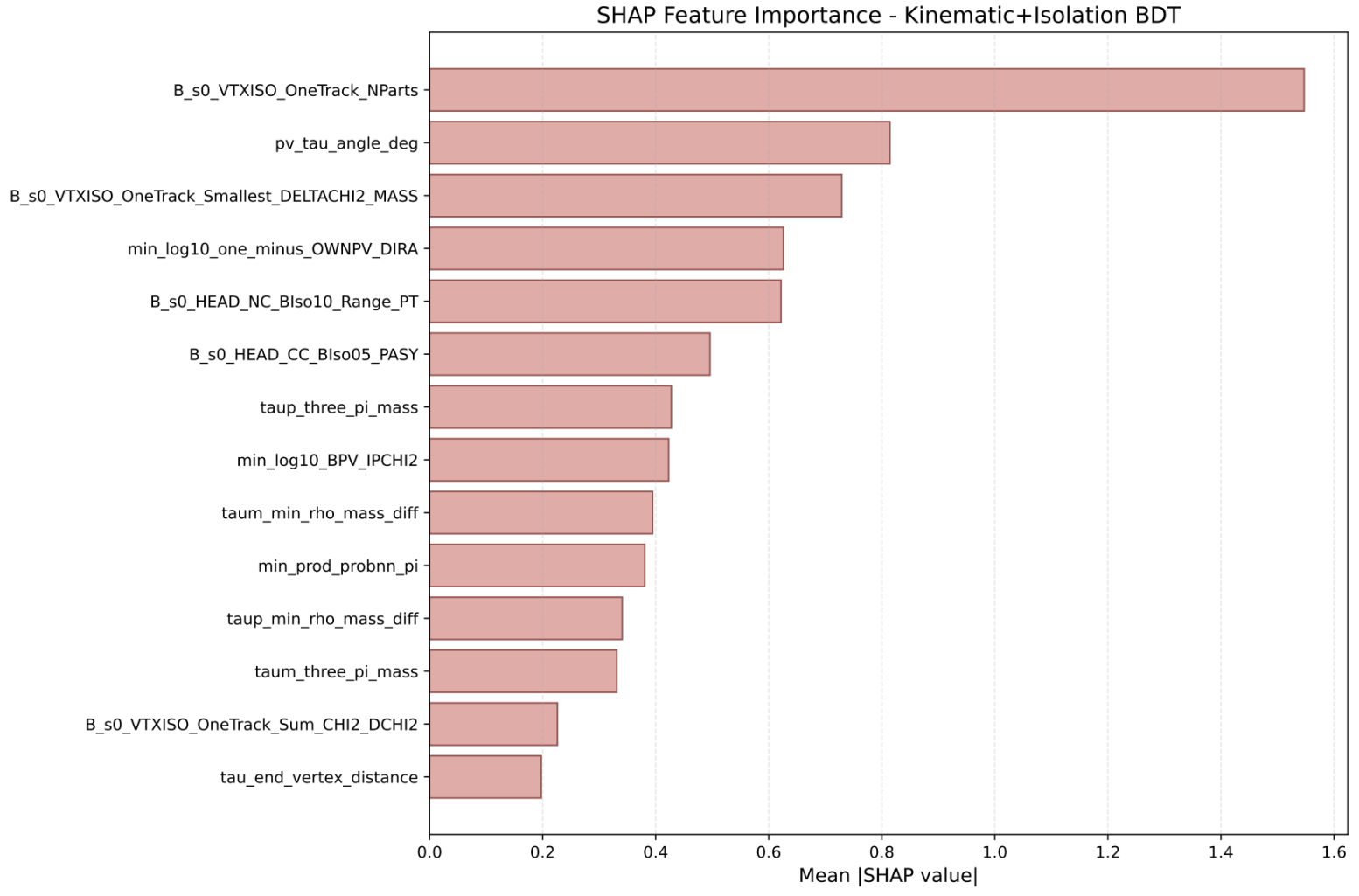
B_s0_VTXISO_OneTrack_NParts dominates by a large margin, followed by the PV–τ angle and the new isolation mass variable. This hierarchy confirms that genuine Bs0 decays are distinguished primarily by their sparse vertex environment — isolated decay vertices with few nearby tracks — a physically intuitive signature.| BDT Threshold | Overall Signal Eff. | Overall SS Data Eff. |
|---|---|---|
| 0.7290 | 70.06% | 0.74% |
| 0.7820 | 65.12% | 0.58% |
| 0.8230 | 60.00% | 0.46% |
| 0.8610 | 55.06% | 0.35% |
| 0.8880 | 50.11% | 0.26% |
Analysis: Physics Background Suppression
B0 → D−3π background
The decay B0 → (D− → π−π+π−π0) π+π−π+ is a serious concern: it produces a 6π + π0 final state where the neutral pion is undetected, giving the same 6-track topology as the signal. The missing π0 mimics the signal's missing neutrinos in terms of kinematic incompleteness. Crucially, its branching ratio (~7.0 × 10⁻⁵) is four orders of magnitude larger than the signal when accounting for the τ → 3π sub-branching ratio, making it a potential limiting background even after the Δm and BDT cuts.
Furthermore, the D− decay proceeds through π0 + a1− → ρ0π−, directly mimicking the τ decay resonance chain that the BDT was trained to identify as signal. The result is that the combinatorial-background BDT is only 35.47% efficient at rejecting this physics background — far worse than the 0.46% achieved against combinatorial background.
Why the BDT fails here: The BDT was trained on Same-Sign data as background proxy, which captures combinatorial background kinematics. The B0 → D−3π decay shares topological features with the signal (secondary vertex, resonance structure, pion PID) that the BDT cannot distinguish.
The 6π Invariant Mass Cut
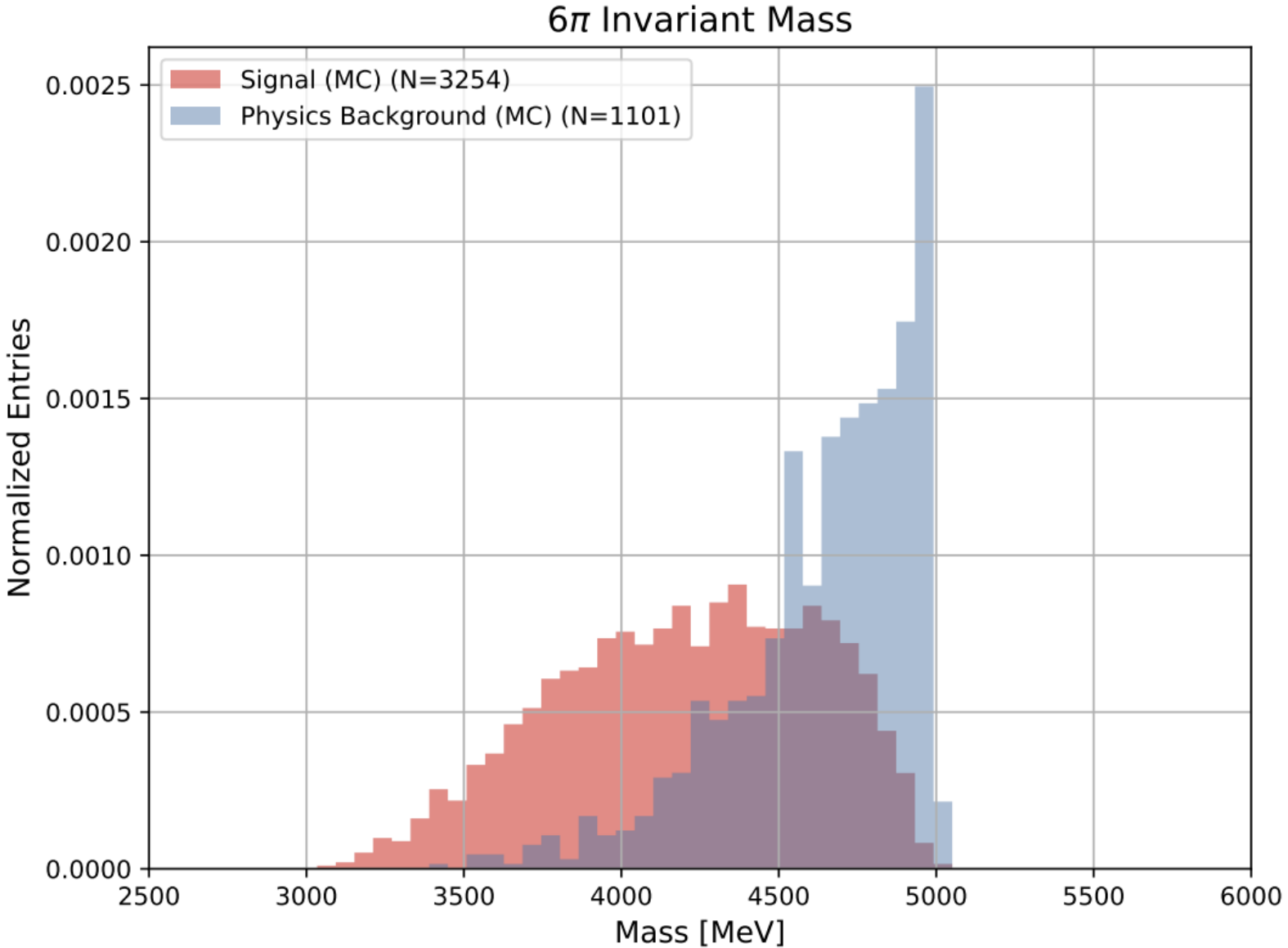
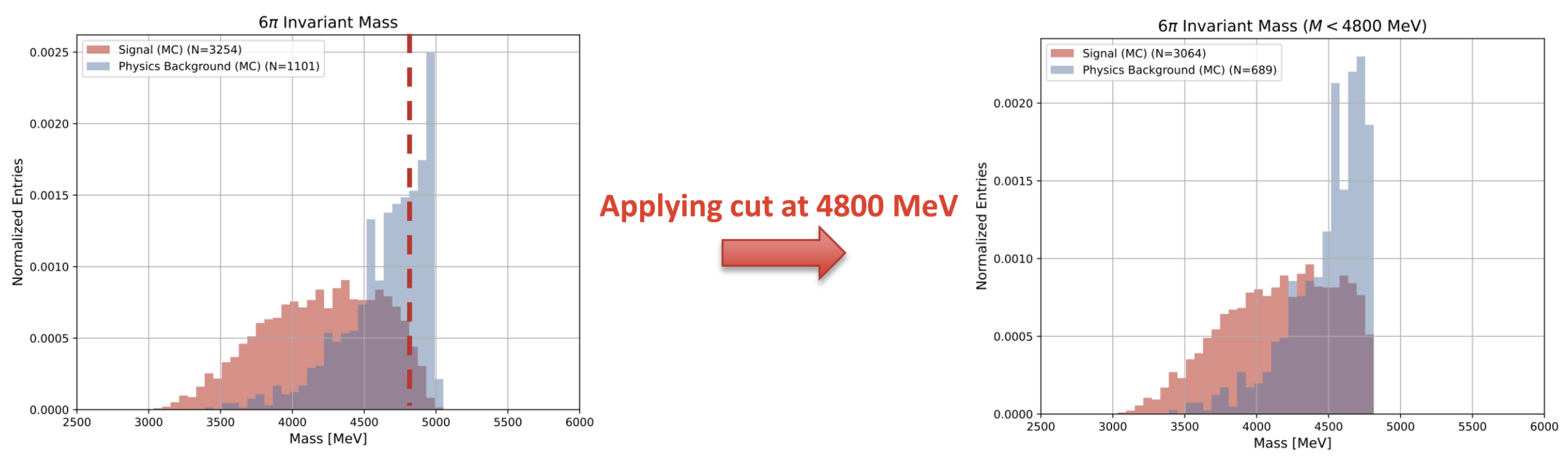
The key discriminating variable turns out to be the total invariant mass of all six charged pions. For the signal, the two missing neutrinos carry away a significant fraction of the energy, so m6π peaks at values well below the Bs0 mass (5367 MeV/c2), forming a broad distribution centred around 3500–4500 MeV/c2. For the B0 → D−3π background, only one π0 is missing (mass 135 MeV/c2), so m6π peaks sharply near the nominal B0 mass (5279 MeV/c2) shifted down by the π0 mass — giving a sharp peak around 4900–5100 MeV/c2 that is clearly separated from the signal region.
| Selection step | MC Signal eff. | B0 → D−3π eff. |
|---|---|---|
| ΔmBs⁰ cut | 92.52% | 95.81% |
| Δm + BDT (threshold 0.8230) | 68.19% | 35.47% |
| m(6π) < 4800 MeV/c² (relative) | 94.16% | 62.58% |
| Total (all three cuts) | 64.21% | 22.20% |
Summary
Improved BDT for combinatorial background: Refining the ρ signature variable and adding two new isolation features with NaN-aware training lifted the XGBoost BDT from AUC 0.932 to 0.957. At the reference threshold, combinatorial background efficiency is halved to 0.46% at 60% signal efficiency.
Vertex isolation as the dominant discriminant: SHAP analysis identified B_s0_VTXISO_OneTrack_NParts as the single most powerful feature, confirming that the sparse vertex environment of a real Bs0 decay is the clearest distinguisher from combinatorial background in the dense LHCb hadronic environment.
Discovery of the 6π mass cut: A novel rectangular cut m(6π) < 4800 MeV/c2 exploits the missing-π0 energy shift in B0 → D−3π events. Combined with the BDT, this brings the physics background total efficiency to 22.20% while preserving 64.21% of signal — a factor of ~5 suppression of this background beyond what the BDT alone achieves.
Outlook: The expected signal yield in the analysed subsample is only 2.26 events. The full 2024 dataset (9.56 fb−1, ~21.6 expected signal events) and improved 2025 HLT2 trigger efficiency will provide the statistics needed for a competitive measurement. Next steps include training a dedicated BDT against the physics background and extending the study to other peaking channels such as Bs0 → Ds+Ds−.
This work forms part of the LPHE group's broader programme searching for lepton-flavour universality violations in B-meson decays at LHCb Run 3, which will ultimately probe the SM branching ratio (7.73 ± 0.49) × 10−7 with sensitivity that was impossible in Run 1 and Run 2.
All Research